
By Syd
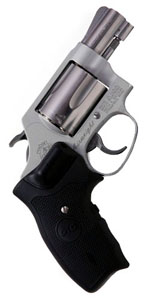
I have often asked myself why, after years of using autoloaders, I found myself drawn to the Smith & Wesson Airweight Chiefs Special revolver. There are some things about this that aren’t the most scientific reasons for selecting a handgun. I guess I’ve been fascinated by snub-noses since the first times I saw Humphrey Bogart and Jimmy Cagney waving them around in old gangster movies. It was the snub-nose which always appeared out of nowhere and changed the situation. The snub-nose has a mystique about it just as surely as the Luger, The Single Action Army Colt, the M1911A1, the PPK you know the list the guns which have become icons. Actually, Id like to own each of these someday, but some lack the utilitarian value to me of the snub-nose. So, while someday, I may own the Lone Rangers six-shooter, I picked up a Model 637 Chiefs Special Airweight in .38 caliber.
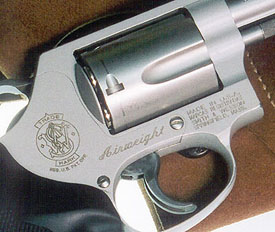
The Model 637 is the 5-shot J-frame built with a stainless steel barrel and cylinder and an aluminum alloy frame with an exposed hammer. It has black rubber Uncle Mikes Boot Grips. The two greatest strengths of this gun are its excellent accuracy and 13.5 ounce weight. Other strengths I would list are the rounded contours of the gun, ease of concealment, its simplicity of operation, and high production values in finish and fit. This particular model is the 637-1, the -1 indicating that it is rated to handle +p ammunition. When I selected the 637 I really struggled with the choice between the 637 and the 640, the Airweight Centennial which is double action only. I settled on the 637 because its exposed hammer allows me to cock it for single action fire which makes for greater accuracy. The 640 is snag free and would be the better choice for pocket carry.
The snub-nose .38 Special is a study in trade-offs. The .38 Special is an excellent cartridge coming out of a 4″ barrel. Launched from a 2″ barrel, it can suffer velocity and expansion problems. On the other hand, a .38 with a 4″ barrel wont fit in your pocket. A snub-nose .38 can launch a bigger bullet than any other pistol of its size and weight, a 158 grain slug, but it can only launch five of them before you have to reload. Its small size and weight make it a dream to carry, but a pain to shoot. Modern .38 Special +p ammunition from Federal, Remington, and Winchester has addressed the velocity and expansion issues fairly well, but the recoil of +p in an Airweight is brisk indeed.
Shooting the snubby: I have medium large hands and the small grip and fast muzzle flip makes the snubby uncomfortable for me to shoot. One time I ran 150 rounds through it in a single session and came away with a blister on the bottom of my trigger finger from the trigger guard snapping up and hitting it. The trigger pull on the snubby is relatively heavy which doesn’t make for pinpoint accuracy, but provides a margin of safety for a gun that gets carried in pockets, purses, fanny packs and all sorts of holsters. Since the barrel is so short, the sight radius does not lend itself to tack-driving accuracy either. However, if you do take the time to get a good sight picture and have good trigger control, the inherent accuracy of the little wheel gun will surprise you.
“Of all handguns probably none of them are harder to master than the belly model. To begin with, it is short and it is light. This coupled with a walloping big caliber spells a punishing recoil. Only a plentitude of firing will accustom the user to the buck and rear of the sawed-off.
A hard-kicking gun can be controlled in only one way: it must he gripped with a powerful hand pressure. Practice a grip on the belly gun that will crush granite. Such a heavy hand will bring the weapon under control and keep it there. Practice on man targets and do not fire at them more than 30 feet. Do not fire single shots, trigger off bursts of 2 or 3. Extend the arm full length in the beginning and simply look over the barrel. Later on commence to break the elbow and hold the gun below eye level. Shots come faster. Accuracy is just as good from this lower position it is just a matter of practice.” Col. Charles Askins, GUNS MAGAZINE, May, 1955 [Editor’s note: I don’t necessarily subscribe to this style of shooting, but Col. Askins was one of the most experienced and successful gunfighters of all time and his methods are worth considering.]
The snub-nose .38 Special competes against guns like the Beretta Tomcat .32, the KelTec P-32, the SIG 230 .380 and the baby Glocks. Each of these have attributes which commend them, and I wouldn’t hesitate to use any of them (well, except maybe for the Glocks sorry, I just don’t like them.). The case for the snub-nose includes cheap ammo, big bullets, simplicity of operation, and excellent reliability.
A while back, I had the opportunity to test one of the S&W titanium 337s which weighs in at a mere 11.9 oz. In my opinion, the weight difference between the 637 and the 337 is not significant enough to justify the $150 price difference between the two guns (or the $250 difference you pay for the scandium versions). The stainless and aluminum alloy versions seem to be much better values to me. I also think the stainless steel of the 637 is better looking than the flat gun metal gray of the titanium parts of the 337. The two guns shoot about the same with brisk recoil and muzzle flip.
My favorite loads for the snubby include the 125g +p Remington Golden Saber, The Cor-Bon DPX, the 110g Hydra-Shok which is a very soft-shooting load, The Speer 135 grain +p and the 129g +p Hydra-Shok. Favorite holsters include the Galco Concealable, Galco Pocket Holster, Galco Ankle Glove, and Galco Classic Lite Shoulder Holster.
Conceptual Issues With the Little Wheel Gun
Criticisms
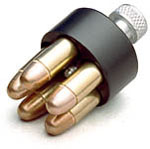 Its always entertaining to me to read the noise that gets passed off as gun wisdom on the Internet, and no subject seems to collect more ill-considered pseudo-truths than the snub-nose revolver. With the disclaimer that if I were forced to choose one pistol for my life, it wouldn’t be a snub-nose .38 Special, I want to address some of the issues and criticisms often leveled at the snub-nose. The big one, of course, is that it only holds five rounds, and I admit that this is my biggest negative with the gun. But think about it a minute unless you are a soldier or a guy who kicks down doors for a living, how often have you actually been in a situation (outside of an IDPA match) in which there was a high likelihood of needing to fire 16-30 rounds? I have read the gun news almost every day for years and the instances in which an armed civilian has been called upon to shoot it out with a gang of heavily armed adversaries are exceedingly rare. And further, the sad fact is that if you have to go up against a half dozen armed people your odds of winning aren’t very good even with a gun that holds 15 rounds. Generally, violent crime is a matter of 1, 2 or 3 against 1 according to Justice Department statistics. The overwhelming majority of people who commit violent crimes against strangers are trying to steal something or commit a sexual assault. These people are looking for a score, not a gunfight. A .38 Special revolver with five or six rounds is quite adequate to dissuade, or if need be, stop this kind of predator, assuming of course that you can put the rounds somewhere that they will incapacitate the attacker. Also, with practice, a revolver can be reloaded as fast, or nearly so, as an auto using speed loaders.
I don’t mean this as an admonition to play the averages. I don’t believe in averages and statistics when it comes to self defense. Murphy is alive and well, and its the thing you don’t plan for that sandbags you. At the same time, real life is not like IPDA stages in which a dozen assailants stand still and let you shoot them. Groups of people, armed or otherwise, don’t behave that way. They scatter, dive for cover, shoot back, or something, but they don’t stand still. This gives you, the tactically-minded survivor, an opportunity to run the other way or take cover and reload. And again, these situations are rare, although not unheard of. Also, if you frequently find yourself in the position of being alone in a gunfight trying to hold off a half dozen armed adversaries, it might be worthwhile to stay at home tomorrow night to reflect upon your life style and social skills. The point Im trying to make is that the snub-nose is enough gun for most civilian self defense needs when it is deployed effectively. Nevertheless, if your threat assessment tells you that you may be facing multiple determined attackers, you should consider a higher capacity firearm. For more discussion on this, see “Why Carry a Revolver?”
(My personal choices of armament for a gunfight include a belt-fed M-60, a company of Marines at my back and close air support, but it’s kind of tedious to get all of that together for a trip to the grocery store. If it sounds like I’m talking out of both sides of my mouth, its because I am. The snubby is an acceptable solution to the problem. Its a whole lot better than throwing rocks, but it is not an optimal solution. A lightweight snubby is a trade-off of firepower for light weight, ease of carry, and conceal-ability.)
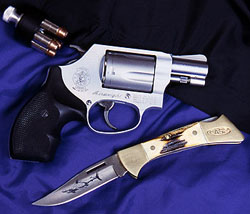 One pseudo-truth I hear a lot is that snub-nose J-frames are the best choice for women, beginners and people who don’t want to practice with their handguns. Why? Loading and firing a Kahr or Glock is not exactly rocket science. A 1911 is only slightly more complicated. Are women and newbies too stupid to learn to operate an autoloader? How do they manage to operate their cars and food processors? I would argue the other way: let the newbies get a nice medium size autoloader with a deep magazine and a full size grip so they can miss a lot and not destroy their hands learning to fire the gun. A larger revolver is also a good choice for a newbie. A snub-nose 5-banger actually requires more skill to use effectively. With only five rounds in the gun, there is a smaller margin for error you cant afford to miss. The heavy trigger and short sight radius require more skill rather than less to achieve accuracy. You have to practice with these guns. Actually, you have to practice with any handgun, but that’s another rant. Especially with the lightweight revolvers, practice can be unpleasant because of the brisk recoil and muzzle flip, so why saddle newbies with little pocket cannons that are going to discourage practice? The only rational reason to put a newbie into a revolver is that they like it better. There is a certain wonderful trustworthiness about a wheel gun. Autos are mysterious with a lot of strange parts and such. Revolvers are simple and obvious. If the newbie has confidence that the revolver is going to work for them when the chips are down, that’s the gun they should get. Then they should buy a case of ammo (and maybe some shooting gloves) and learn how to use it.
Another criticism of the snub-nose is that its underpowered the short barrel doesn’t give the powder enough time to burn to develop adequate velocity. While the short barrel certainly costs you some muzzle velocity, I believe that this is a criticism based largely on yesterdays ammo, and it should be revisited. With modern +p loads, the snub-nose can kick out a 125g bullet at 850 900 fps. It can spit out the 158g at around 800 850 fps. At 900 fps a 125g bullet can shoot clean through a normal sized human being. While the .38 Special lacks the terminal ballistics of the .45 ACP and the velocity of the 9mm, its power to weight ratio is actually pretty good with the right ammunition. It is capable of doing the job. The power factor of the .38 Special revolver is the main reason I prefer it to a small auto like a .32 or .380 (and yes, I’ve read the Marshall & Sanow stats and I don’t believe a word of it.). The snubby is still the only handgun I know of that weighs 13 ounces and can launch a 158g bullet. For more on snubby ballistics, click here.
The last of the frequent criticisms of the snub-nose is that it isn’t very accurate. This isn’t really true, but I know why people think it. The snub-nose is not a gun that is easy to shoot accurately, but it is capable of surprising accuracy. On an episode of American Shooter hosted by Jim Scoutten, I saw trick shooter Bob Munden (see http://www.bobmunden.com/ ) hit a balloon the size of a saucer at 150 yards with a snub-nose .38. I think he had to fire twice, once to get the range and then the second shot hit. I have proven it to myself by consistently knocking down the small 18 tall x 6 wide pepper poppers at 25 yards. Now, to do this, I have to really take my time, aim carefully and fire single action, but I have established to my own satisfaction that the snubby can actually hit things at long range when I do the things I should.
 The Good Stuff
I’m an auto guy. With the exception of firing a few old .38’s when I was a kid, I cut my teeth on autoloaders particularly the M1911 and various 9mms. For serious business and matches, I still prefer autoloaders. I like their speed in firing and reloading. I have never found a gun that I shoot better than the M1911. With that said, I’m not blind to the appeal of wheel guns. There is a certain solid dependability about a wheel gun. It is simple and intuitive, and in its own way, perfect. To my way of thinking, the auto is faster and has better firepower, but there’s no squirrelly jazz about a revolver. It’s pretty obvious that it’s loaded, and there’s no safety or de-cocking levers to worry about. There are no magazines to fail, no research project to find out which ammo runs reliably, no carefully tuned mechanism to transfer cartridges to the chamber from the magazine in short, the revolver is a simple and dependable mechanism. While it is technically possible for a revolver to jam, it is a rare event usually brought about by a failure of ammunition to hold together under the recoil cycle of the gun or crud build-up under the ejector star. I have managed to jam almost every autoloader I own but I have never jammed a revolver. I have seen every variety of autoloader jam and fail in match and training settings. I can tell you particular models of autoloaders that have never failed on me, but the possibility of a jam or magazine failure is always in the back of my mind and we have to train for malfunction recovery. It’s just part of the course for training people on autos. With a wheel gun, we don’t worry so much about malfunctions. We worry about learning to reload fast enough to survive a fight. We worry about finding ammo that will achieve the necessary velocity and expansion, but malfunction recovery just isn’t high on the list of worries when it comes to wheel guns. A lot of people like these characteristics of revolvers.
Recently, I suffered a pair of painful back injuries one was the result of moving a load of drywall, and then a serious exacerbation of the injury happened in a fall on a set of stairs. I could scarcely tighten my belt enough to keep my pants up, much less endure a two pound gun and spare magazines riding on my belt and pressing against my lower back. In this sad state of disrepair, I was suddenly seeing my Airweight 637 in a whole new light. At 13.5 ounces and endowed with a really simple manual of arms, the snub-nose was a viable solution. I ordered a Galco Classic Lite shoulder holster so I wouldn’t have to endure a chunk of metal in my belt, and I had a rig that I could wear without discomfort.
The small snub-noses have ergonomics that even the smallest auto of comparable caliber fail to achieve. I have talked to police officers who have actually traded their baby Glock backups for J-frame revolvers because the small Glocks just don’t conceal or carry as well. The snub-nose remains to me the most concealable of guns of significant caliber. The rounded grip and small front end allows the gun to blend itself into the natural curves of the human body, making it an extremely easy gun to make disappear. It is comfortable to wear because it lacks the corners and levers which can dig into your body, and its light.
Tying the Threads Together
The snub-nose .38 revolver is probably the most under-appreciated and overly criticized personal defense handgun ever. I suspect that in our haste to justify our lust for the latest whiz-bang autoloader, the snubby has taken a critical pounding that would leave the casual observer with the impression that the gun couldn’t stop a rampaging grasshopper and is as slow to reload as a Brown Bess musket. Much of this is undeserved. Its days as a primary sidearm for law enforcement are surely over, but it remains very popular among peace officers in the backup and off-duty carry roles. A non-scientific survey of gun shop display cases revealed to me that that compact revolvers remain very popular with the public. Their prices have gone up in recent years, and few deals can be found on nice used specimens, especially on the lightweight +p rated models.
A lot of misinformation goes around about the snubbies, particularly that they are the ideal gun for beginners and non-dedicated personnel (meaning folks that don’t want to practice). I would argue that the snub-nose is not the best first gun. It is actually more demanding of the operator in the tactical context. The snub-nose is capable of significant accuracy and is possessed of adequate stopping power to perform the self defense role. For the person who adopts the .38 snub-nose as their personal self defense tool, extensive practice at rapid shot placement and reloading is encouraged in the strongest terms. Firepower (meaning the art of putting a lot of lead in the air quickly) is this guns weakness. One might even consider carrying a pair of snubbies so that an emergency reload is less likely.
Its days as the detectives best friend may be over, but the snub-nose .38 Special remains a dependable, effective handgun, a delight to carry, and a classic realization of the fighting handgun. And besides, its the only handgun my girlfriend ever called sexy. (I still haven’t figured out what she meant by that, but far be it from me to look a gift horse in the mouth.)
Additional Reading:
Making the J-Frame .38 Snub Work
The .38 Snub Old Fashioned Or Old Faithful?
Self-Defense loads for the 2-inch .38 Special
S&W Model 637 Airweight (.38 Special+P) – by Kim Du Toit
Comments, suggestions, contributions? Contact me here